By the PEMCO Engineering Team, Lahore. Updated 27 November 2026.
Short answer
- There is no single best hybrid inverter brand in Pakistan. The best one is the model that matches your meter, your backup load, your battery and your roof, and that has a real warranty in Pakistan.
- If you ever want to export to the grid, it must be a grid-tied hybrid with anti-islanding. NEPRA’s 2026 rules ask for UL 1741 compliance, and many cheap “hybrid” units are off-grid inverter-chargers that cannot export at all.
- New net billing connections are for three-phase consumers only, so a single-phase house should treat its inverter as self-use until the meter is upgraded.
- Sellers’ published prices in November 2026: about Rs1.2-1.9 lakh for 5-6 kW, Rs2.9-5 lakh for 10 kW single-phase.
Ask ten installers in Lahore which hybrid inverter is best and you will hear ten brand names. Most of them are fine. The expensive mistakes we see come from buying the wrong type, the wrong size or a unit with no warranty behind it, not from picking the “wrong” logo.
First check: is it really a grid-tied hybrid?
In Pakistani shops, “hybrid” is used for two very different machines, and only one of them can feed the grid.
The first is an off-grid inverter-charger. It takes solar, a battery and WAPDA as an input and powers your house, but it cannot send a single unit back to the grid. Growatt’s own range shows the difference clearly: its SPF series is off-grid, while the SPH series is a hybrid that can tie to the grid. Many budget brands sell only the first kind and still call it hybrid.
The second is a grid-tied hybrid. It runs in parallel with the grid, can export surplus solar, and shuts down within a fraction of a second when the grid fails (anti-islanding), so a lineman working on a “dead” line is not electrocuted by your roof.
Pakistani rules only accept the second kind for export. Regulation 9(5) of NEPRA’s Prosumer Regulations 2026 says grid-connected inverters must comply with UL 1741, and regulation 9(3) requires automatic means to stop reconnection until grid voltage and frequency are stable. FESCO’s checklist puts it in plain words: the inverter must be of grid-tied type.
If you never plan to export, an off-grid inverter-charger can still be a sensible, cheaper backup machine. Just buy it knowing that is what it is. Our on-grid vs hybrid vs off-grid guide explains which system suits which house.
Single-phase or three-phase: your meter decides
Under the 2026 rules, only three-phase (400V or 11kV) consumers can apply to connect solar to the grid. That is in the definition of “applicant” in NEPRA’s regulations, and the capacity cannot exceed your sanctioned load.
So the meter decides a lot. On a three-phase connection where you want net billing, a three-phase hybrid keeps the application simple and balances the load across phases. On a single-phase house, a single-phase hybrid is fine for running the home on solar and battery, set to zero export, until you upgrade the connection. Our LESCO net billing application guide covers the upgrade and the paperwork.
Do not buy a single-phase unit for a three-phase house just because it is cheaper. You end up with one heavily loaded phase and two phases the solar never touches.
The specs that actually matter
Size the inverter for what it must run during load-shedding, then check the solar input and battery side. The kW printed on the front is only the start.
| Spec on the datasheet | What to look for | Why it matters here |
|---|---|---|
| Rated output (kW) | Your backup load plus 25-30% headroom | ACs, water motors and fridges draw a surge when they start |
| Max PV input (Wp) | About 130-160% of the rated output, or more | More panels per inverter, more output in winter and smog |
| Number of MPPTs | Two if your panels face two directions or get different shade | A water tank shading one string should not drag down the other |
| Battery voltage | LV (48V) or HV (roughly 80-600V), matched to the battery | The two are not interchangeable |
| Max charge current | High enough to refill your battery between cuts | Load-shedding in short gaps leaves little charging time |
| Switch-over time | 10 ms or less; under 4 ms if you run computers | Slower units let routers and PCs reboot |
| Operating temperature, IP rating | Rated to +60°C, IP65 or better if it is outdoors | Punjab summers and dust |
| Grid standards | UL 1741 and/or IEC 62116, IEC 61727 listed | Needed for export approval |
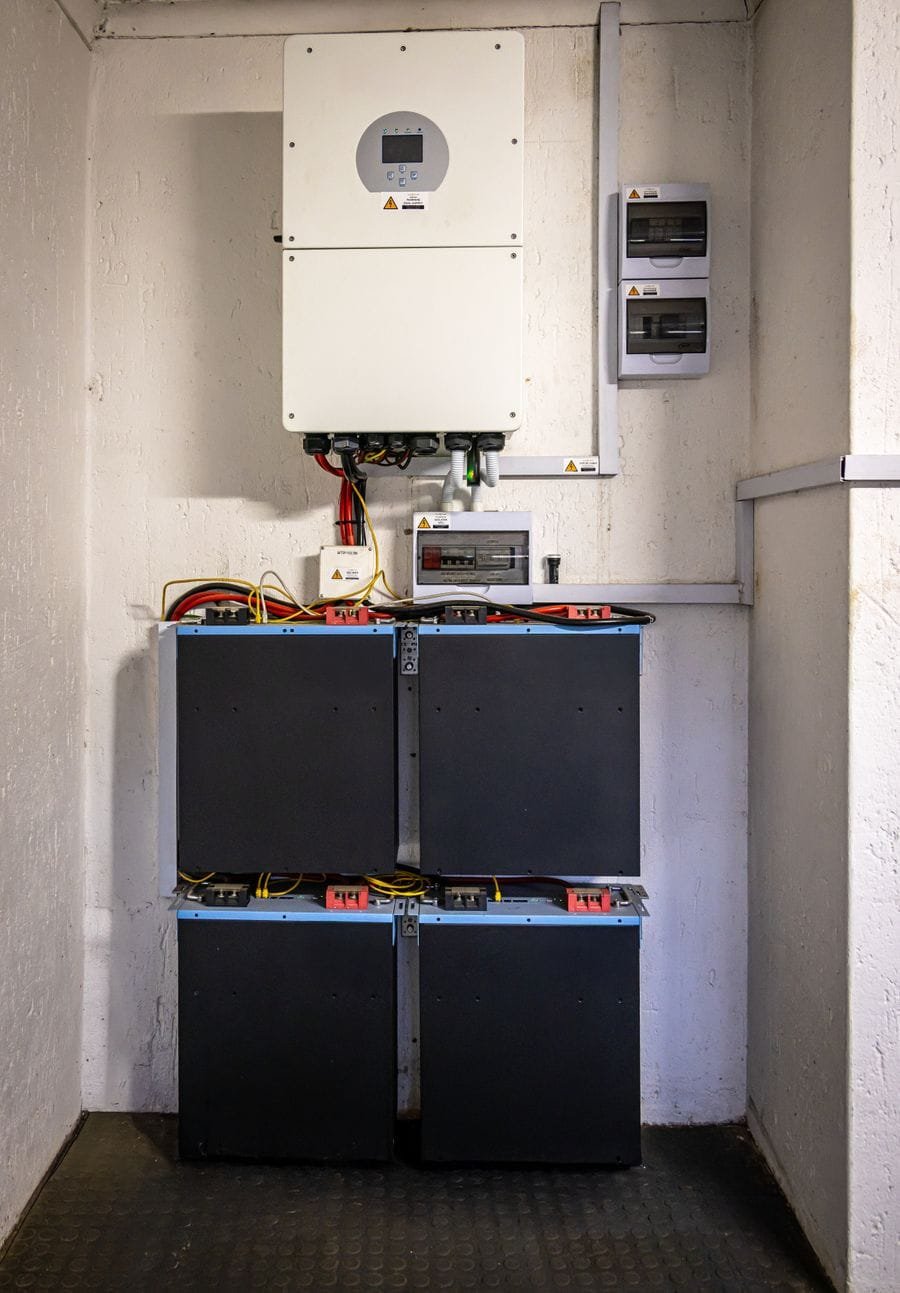
A rough guide to size: a house that wants one 1.5-ton inverter AC plus fans, lights and a fridge through load-shedding usually needs at least 6 kW, and 8 kW is more comfortable. Two ACs together point to 10 kW or a three-phase unit. The inverter does not set your battery size; your night use does, which our lithium battery sizing guide works through.
Heat, dust and voltage: the Punjab test
An inverter that is happy in a European loft can struggle on a Lahore roof in June. Three things to check.
1. Temperature rating and derating
Inverters reduce their output when they get hot, and they age faster. Ratings differ more than people expect. Solis lists its S6 L-PLUS hybrids for -25 to +60°C, while a Pakistani listing for one 6 kW Tesla-branded model gives -25 to 50°C. SolaX notes on one hybrid datasheet that derating starts above +45°C. Lahore afternoons pass 40°C for weeks in summer, and a wall in direct sun is hotter than the air.
Where you mount it matters as much as which brand you buy. Put it on a north or east-facing wall, in the shade of the stair tower or under a canopy, with the air gap the manual asks for. Never inside a closed tin box.
2. Dust
Fan-cooled units pull Punjab’s fine dust through their heat sinks. If the inverter will sit outdoors, look for IP65 or IP66 and check whether the fans are sealed or replaceable. Indoor units with open vents need cleaning before every summer.
3. Grid voltage window
NEPRA allows ±5% on voltage and ±1% on frequency at the connection point, but on overloaded feeders in summer the voltage often sags further. An inverter with a narrow AC window keeps dropping off the grid and switching to battery. Sungrow’s SH-RS datasheet, for example, lists an AC range of 154-276 V. Ask for the figure for any model you are quoted.
Not sure what your house needs?
WhatsApp us a photo of your electricity meter, your last bill and a list of what you want running during load-shedding. Our engineers will tell you the inverter size and type on a video call, whatever brand you end up buying. Free site survey in Lahore and nearby areas, video consultation anywhere in Punjab.
Battery compatibility
Choose the inverter and battery as a pair. The voltage must match, and the two should talk to each other.
Most Pakistani homes use 48V lithium packs, so most home hybrids are low-voltage. Some well-known models are high-voltage only: Sungrow’s single-phase SH-RS hybrids take a Li-ion battery of 80-460 V, so the common 48V packs will not work with them. That is not a flaw, just a different system that needs a matching, usually costlier, battery.
Then check communication. A battery that is on the inverter maker’s compatibility list and talks over CAN or RS485 charges correctly and protects itself. One that does not is run on rough voltage settings and wears out sooner. If you still use tubular lead-acid batteries, make sure the inverter supports them; our lithium vs lead-acid comparison explains why most new systems now skip them.
Warranty and the grey market
A five-year warranty is only worth something if someone in Pakistan will honour it. Inverters imported outside the official channel can be genuine and still carry no local warranty. Pakistan’s official Huawei solar distributor told Energy Update that grey-channel products are freely available and their warranty is not valid in Pakistan, leaving buyers with nowhere to go.
- Check the serial number with the brand’s official importer in Pakistan before paying.
- Ask who repairs it in your city and how long a replacement takes. A dead inverter in June is worse than a slightly dearer one.
- Ask whether the warranty is replacement or repair. Repair-only cover can mean weeks without solar.
- Get the warranty card stamped with the seller’s name and the installation date.
- Keep the inverter’s own app or portal registered in your name, not the installer’s.
Brands we have installed, and where each fits
Inverter brands we have installed include Inverex, Growatt, Solis, Sungrow and Tesla, among others. This is a list, not a ranking. Each has models we would happily fit and models we would steer a client away from, which is why the checks above matter more than the badge.
Inverex
A familiar name in almost every Pakistani solar market, so parts and technicians are easy to find. The Nitrox hybrid range runs from single-phase 48V units to three-phase LV models; the 6 kW datasheet lists 7,800 W of panels, zero export, IP65 and a 5-year warranty. Watch the model name: Inverex also sells on-grid-only Nitrox units with no battery port.
Growatt
A very wide range, which is both its strength and the trap. As above, SPF models are off-grid and SPH models are grid-tie hybrids. Read the full model code on the quote, and buy through the official channel so the warranty is valid here.
Solis
The S6 L-PLUS single-phase hybrids are LV (48V) units that, per the datasheet, accept PV up to 160% of rated power, are IP66 and are rated to +60°C. A good fit for an outdoor wall in the heat. The datasheets for its PRO models list IEC 62116 and IEC 61727 among their grid standards.
Sungrow
The SH-RS single-phase hybrids are high-voltage battery systems with a wide AC window, and the SH5.0RS-20 accepts up to 12,000 Wp of panels. They suit a planned system built around a matching HV battery, not a quick swap onto an existing 48V pack.
Tesla-branded inverters sold in Pakistan
Several Pakistani shops sell Tesla-branded hybrids (HLE and Infinity ranges), mostly 48V single-phase units that can run in parallel. Some listings borrow Powerwall wording, so ask which company makes and services the exact unit, confirm the model supports grid feed-in if you need it, and note its temperature rating.
You will also see GoodWe, SAJ, Auxsol, Crown Micro, Knox, Max Power and others in quotes. Apply the same checks to each: grid-tie type and standards, phase, PV input, battery match, heat rating and local warranty.
What hybrid inverters cost in late 2026
For the same size, published prices run from budget to premium by a factor of two or more. These are other sellers’ figures, checked on 27 November 2026, not PEMCO prices.
| Size and type | Published price (PKR) | Source |
|---|---|---|
| 3-4 kW single-phase | 68,000-225,000 | SolarRate.pk, 24 dealer listings for 4 kW hybrids (Nov 2026) |
| 5 kW single-phase | 1.2-1.4 lakh (Growatt SPH 5 kW) | AMS Security Vision price index (updated 17 Nov 2026) |
| 6 kW single-phase | 1.5-1.94 lakh | MartOnline (2 Nov 2026, excl. GST) |
| 8 kW single-phase | 2.35-2.97 lakh | MartOnline (2 Nov 2026, excl. GST) |
| 10 kW single-phase | 2.9-5.0 lakh | MartOnline; AMS (Solis 10 kW L-PLUS 3.5-3.6 lakh); SolarPanelPrices.pk (Inverex Nitrox 10 kW, Rs4.99 lakh) |
| 12 kW three-phase | from about 4.4 lakh | MartOnline (2 Nov 2026, excl. GST) |
The cheapest unit at a given size is often the off-grid kind, a 24V model or one with far less PV input, so compare like for like. For what the inverter adds to a full system, see our solar system price guide for 2026.
Frequently asked questions
Which hybrid inverter brand is best in Pakistan?
No single brand is best for every house. Pick a grid-tied hybrid that matches your meter’s phase, your backup load and your battery voltage, is rated for Punjab’s heat, lists UL 1741 or IEC grid standards, and has a warranty honoured by an official importer in Pakistan.
Can I get net billing with a single-phase hybrid inverter?
Not on a single-phase connection. NEPRA’s 2026 rules only accept three-phase (400V or 11kV) consumers as applicants. A single-phase house can still use a hybrid for its own consumption with export set to zero, and apply once the connection is upgraded.
What size hybrid inverter do I need for a 1.5-ton AC?
With fans, lights and a fridge running too, plan on at least 6 kW, and 8 kW for comfortable headroom. For two 1.5-ton ACs at the same time, look at 10 kW single-phase or a three-phase unit.
Do hybrid inverters work without a battery?
Many do. Inverex lists battery-less operation for its Nitrox 6 kW, and several other brands run on solar and grid alone. Some off-grid inverter-chargers need a battery to start, so check the datasheet.
How long does a hybrid inverter last?
Standard warranties in Pakistan are usually 5 years, with some brands offering 6-10. Panels outlast inverters, so plan for at least one inverter repair or replacement over the life of the system, and mount it in shade to give it the best chance.
Get the inverter right the first time
PEMCO Engineering has installed more than 1 MW of solar, with over a decade of experience across 7+ Punjab cities. See our solar system installation service, or our pages for solar installation in Lahore and Islamabad. Call 0322 4773987, WhatsApp us, or use the contact form for a free consultation.
Written by the PEMCO Engineering Team. Regulations from NEPRA’s Prosumer Regulations 2026 (SRO 251(I)/2026) and FESCO’s net metering checklist. Specifications from the makers’ datasheets and listings linked above. Prices are other sellers’ published figures, checked on 27 November 2026; they are not PEMCO prices or quotations. Sizing guidance is our engineering judgement.