
By the PEMCO Engineering Team, Lahore. Updated 26 November 2026.
Short answer
- In late 2026 a 5 kWh lithium (LiFePO4) battery costs about Rs2-2.75 lakh in Pakistan, and most branded 48V packs sit around Rs2.3-2.6 lakh.
- A 10 kWh bank is about Rs4.5-6 lakh. Sellers’ published rates work out to roughly Rs45,000-65,000 per kWh.
- Size it from your night-time and load-shedding use in kWh, not from your inverter’s kW rating. A 5 kWh pack runs fans, lights, a fridge and a router through the night, but not an AC.
- Under net billing a battery pays back only if it is filled with surplus solar and emptied every evening. If you have no surplus, it is backup, not savings.
Since net billing started, the battery has become the part of a solar quote people argue about most. The price is easy to look up. The sizing is where people lose money, by buying a pack that is too small to matter or too big to ever fill.
Lithium battery prices by capacity
For the same capacity, published 2026 prices differ by a third or more, so use the table to judge a quote, not to fix one. These are other companies’ figures, collected on 26 November 2026. They are not PEMCO prices.
| Battery size (LiFePO4) | Published price range (PKR) | What it typically covers | Source |
|---|---|---|---|
| 2.5 kWh (24V or 48V) | 1.3-1.65 lakh | A few fans and lights for 4-6 hours | Solar Pakistan Guide (Nov 2026), CNC Electric (Jun 2026) |
| 5-5.12 kWh (48V, 100Ah) | 2.0-2.75 lakh; most quotes 2.3-2.6 lakh | Night load of a 5-10 marla house without AC | Solar Pakistan Guide, Aston Energy (Sep 2026), Solar Citizen (Oct 2026) |
| 10 kWh (48V, 200Ah) | 4.5-6.0 lakh | Night load plus a few hours of one inverter AC | Solar Citizen, CNC Electric |
| 15-16 kWh | 6.2-7.9 lakh | Larger houses, long load-shedding, small offices | Solar Citizen, Solar Pakistan Guide, ProPakistani (Sep 2026) |
| 20 kWh | 10.3-13.0 lakh | 1 kanal houses with two ACs at night | Solar Citizen |
Prices have eased this year. In June, ahead of the budget, ProPakistani reported a “5kW” lithium battery selling for Rs2.6-2.7 lakh. By September, its Lahore market report put the same class at Rs2.3 lakh, and a “16kW” battery down from Rs7.5 lakh to Rs6.5 lakh.
Do not expect batteries to become dramatically cheaper soon. In October, the Pakistan Solar Association told a parliamentary caucus that taxes and customs duties add up to 35-40% on battery imports, and that a basic 5 kWh battery still costs more than Rs2.5 lakh. Demand is not slowing either: the same report says Pakistan imported more than 4.5 GW of battery storage equipment in the first half of 2026 alone.
“5 kW battery” or 5 kWh? Read the label
A battery’s size is its energy in kWh. Shops in Pakistan often sell it by the inverter size instead, and that causes most of the confusion in quotes.
The number that matters is printed on the spec sheet as volts times amp-hours. A 51.2V, 100Ah pack holds 51.2 x 100 = 5,120 Wh, or 5.12 kWh. A 25.6V, 100Ah pack holds half that, 2.56 kWh, even though both say “100Ah” in big letters.
Next, check the usable energy. A battery is never run down to zero. Pylontech’s US5000, for example, is rated at 4.8 kWh nominal and 4.56 kWh usable (95% depth of discharge). Then the inverter loses a few percent turning DC into AC. In practice, plan on getting about 85-90% of the label figure at your sockets.
Why two 5 kWh batteries differ by Rs70,000
The gap usually comes from the cells, the warranty and who stands behind it in Pakistan, not from the box. Here is what moves the price.
- Brand and cell grade. Aston Energy’s September list puts 5.12 kWh packs from Dyness, Pylontech, Knox and others between Rs2.0 and 2.8 lakh. Solar Citizen’s brand table runs from about Rs45,000 per kWh for value brands to over Rs65,000 for premium ones.
- Low voltage or high voltage. Most homes use 48V packs. High-voltage stacks (used with some three-phase hybrid inverters) cost more per kWh and only work with a matching inverter.
- Inverter communication. A battery that “talks” to your inverter over CAN or RS485 charges and protects itself properly. A cheap pack that cannot is run on rough voltage settings and ages faster.
- Warranty terms. Published local warranties run from 3 years for some budget brands (CNC Electric’s June table) to 10 years for some premium ones. Ask whether it is a full replacement or only a guarantee of, say, 70% capacity at year 10, and whether it is the importer’s or only the shop’s.
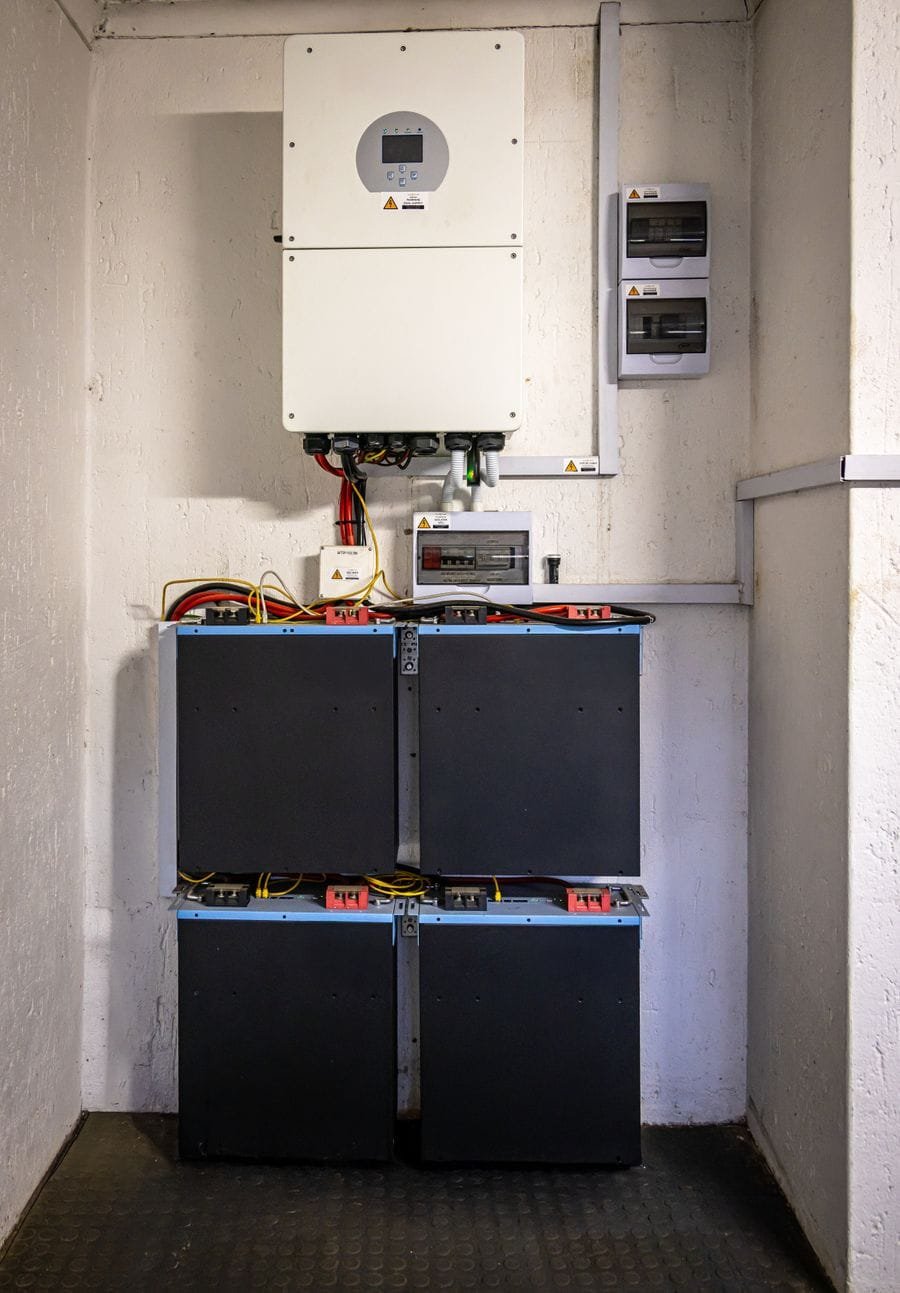
- Rack or wall-mount. Wall-mount units with a neat cover cost more than rack modules with the same cells.
Cycle life is the honest way to compare. Pylontech’s datasheet claims more than 6,000 cycles at 25°C. If a pack really lasts 6,000 cycles, a daily cycle gives about 16 years. Treat those numbers as the maker’s lab figures: Pakistani summers are hotter than 25°C, and heat shortens battery life.
Not sure what size battery your house needs?
WhatsApp us your last electricity bill and a list of what you want to run during load-shedding. Our engineers will work out the kWh with you on a video call. Free site survey in Lahore and nearby areas, video consultation anywhere in Punjab.
How to size a battery for your home
Work in kWh: what you will run, for how many hours, when the sun is not there. It takes ten minutes with a pen.
1. List the loads you want at night or in load-shedding
Write down each appliance’s watts and the hours you need it. Ceiling fans draw about 60-80W each (DC inverter fans far less), LED lights about 10W, a fridge averages roughly 100-150W across a day as its compressor cycles, a router 10-15W. A 1-ton inverter AC typically draws 700-1,000W once the room has cooled.
2. Multiply and add
| Example: 10 marla house, 7 pm to 6 am | Watts | Hours | Energy |
|---|---|---|---|
| 4 ceiling fans | 300 | 9 | 2.7 kWh |
| 10 LED lights | 100 | 5 | 0.5 kWh |
| Fridge (average) | 120 | 11 | 1.3 kWh |
| Router, TV, phone charging | 100 | 4 | 0.4 kWh |
| Total without AC | about 4.9 kWh | ||
| Add one 1-ton inverter AC | 850 | 6 | +5.1 kWh |
| Total with one AC | about 10 kWh |
3. Convert to battery size
Divide the total by about 0.85 to cover depth of discharge and inverter losses. The 4.9 kWh night above needs about 5.8 kWh of battery, so a single 5 kWh pack covers most of it and the grid covers the last hour. Add the AC and you need around 12 kWh, which in practice means two 5-6 kWh packs or one large bank.
4. Check you can refill it from the sun
This is the step most quotes skip. A battery is only as good as the surplus solar available to charge it. In north Punjab a kW of panels produces roughly 6.4-6.8 units a day in spring and summer but only about 3.75 in winter, according to the profileSOLAR figures we cite on our Rawalpindi solar page. Filling a 10 kWh battery on a December day can need 2.5-3 kW of panels on top of what the house uses in daylight.
A battery that is never full is money sitting on a wall. If your roof is small, a smaller pack that fills every day beats a big one that never does.
Does a battery pay for itself under net billing?
Sometimes. It pays when it moves your own surplus daytime solar into the evening, because each stored unit then saves your full tariff instead of earning the export rate.
Since 9 February 2026, new solar connections get net billing. Exported units are credited at about Rs8.13 per unit, while imported units cost your normal tariff, often Rs40-55 for a mid-sized house. Our net billing guide explains the rules.
Take a 5 kWh battery at Rs2.5 lakh that is filled with surplus solar and emptied every evening. It delivers about 4.3 units a day. Each unit stored instead of exported is worth roughly Rs50 minus Rs8, so about Rs42. That is around Rs180 a day, or about Rs66,000 a year, giving a simple payback of roughly 4 years. This is our arithmetic at a flat Rs50 tariff, not a promise.
Now the cases where it does not pay:
- No daytime surplus. If the house uses all its solar in the day, the battery gets charged from the grid at night rates you already pay. It saves nothing; it is only backup.
- Existing net metering users. If you still have an old net metering agreement, exports are credited far better, so a battery adds little until that agreement ends.
- Stable feeder, low night use. If load-shedding is rare in your area and your evenings are light, an on-grid system without a battery usually gives the faster payback. Our on-grid vs hybrid vs off-grid guide works through this choice.
Load-shedding changes the sums in a way no payback table shows. For many families in Punjab the real reason to buy a battery is a quiet, cool night for children and elderly parents, and that is a fair reason. Just know which one you are paying for.
Fakes, warranty and where to keep it
Several Pakistani sellers now warn openly that batteries are the most counterfeited part of a solar system. Solar Citizen says quotes far below the normal range usually mean reclaimed or B-grade cells, and in October an MNA at the parliamentary caucus called for testing standards against “substandard batteries”.
- Verify the serial number with the brand or its official importer, not with the shop.
- Check the manufacturing date on the pack. A battery that sat in a hot godown for a year has already aged.
- Get the warranty card stamped with the dealer’s name, and ask who services it in your city.
- Look for safety certificates such as IEC 62619 and UN38.3 on the datasheet. Pylontech lists both for the US5000.
- Be wary of a price far below the table above. Lithium cells are a world commodity; nobody sells genuine Grade-A packs at half price.
If you are still deciding between lithium and tubular lead-acid, our lithium vs lead-acid comparison covers depth of discharge, lifespan and space. For what the battery adds to a full system price, see our solar system price guide for 2026.
Frequently asked questions
What is the price of a 5 kWh lithium battery in Pakistan?
Pakistani sellers’ published prices in late 2026 put a 5-5.12 kWh LiFePO4 battery at about Rs2-2.75 lakh, with most branded 48V, 100Ah packs around Rs2.3-2.6 lakh. Brand, warranty and whether GST is included explain most of the difference.
How long will a 5 kWh battery run my house?
About 4.3 kWh reaches your sockets. That runs four fans, lights, a fridge and a router through a night of roughly 10 hours, or a 1-ton inverter AC for about 4-5 hours on its own.
How many batteries do I need for a 10 kW solar system?
The inverter or panel size does not decide it. Your night and load-shedding use does. Many 10 kW houses manage with 10 kWh; houses that want an AC running at night usually need 15 kWh or more, and enough panels to refill it.
How long does a lithium battery last?
Good LiFePO4 packs are rated for around 6,000 cycles at 25°C, which is over 15 years at one cycle a day in the lab. In Pakistan’s heat, plan on less, and compare warranties rather than advertised cycle counts.
Will lithium battery prices fall further?
They dropped by Rs20,000-1 lakh between June and September 2026, depending on size. But the industry says taxes and duties still add 35-40% on imports, and demand is at a record, so large further drops are not certain.
Size the battery before you buy it
PEMCO Engineering has installed more than 1 MW of solar, with over a decade of experience across 7+ Punjab cities. Inverter brands we have installed include Inverex, Growatt, Solis and Sungrow. See our solar system installation service, or our pages for Lahore and Islamabad. Call or WhatsApp 0322 4773987, or use the contact form for a free consultation.
Written by the PEMCO Engineering Team. Battery prices are other companies’ published estimates, checked on 26 November 2026; they are not PEMCO prices or quotations. Specifications from Pylontech’s US5000 datasheet. Market and tax figures as reported by ProPakistani. Sizing and payback figures are our illustrative arithmetic.