By the PEMCO Engineering Team, Lahore. Updated 15 November 2026.
Short answer
- A lift for home in Pakistan usually means one of three things: a compact traction lift in a small shaft, a platform or screw-drive lift for one or two people, or a hydraulic lift for two or three stops.
- Most compact home lifts need a footprint of roughly 1.2 to 1.5 m each way. Pit depth runs from almost nothing to about 200 mm for home models, against a metre or more for a standard plaza lift.
- Running cost is low: the motor itself uses around 10 units a month in a normal house. Standby power for the controller, light and fan often costs more than the trips.
- Plan for load-shedding backup (ELD/ARD) from day one. DHA Lahore makes it mandatory even for houses.
We get the same three questions from almost every family that calls about a home lift: will it fit, what kind should we get, and what will it do to our electricity bill? This guide answers all three with real dimensions from manufacturers’ data, Pakistani rules, and a worked bill example.
Types of home lift that suit Pakistani houses
The right type depends mostly on whether your house already has a shaft, how many floors you need, and who will ride it. Finishes and brand come later.
1. Compact traction lift (with or without machine room)
A motor pulls the cabin on ropes or belts against a counterweight. This is the most common choice in new Pakistani houses of three or more storeys. Machine-room-less (MRL) versions put the motor inside the shaft, so you don’t need a room on the roof. KONE’s MonoSpace Home, for example, needs a pit of only 200 mm and overhead clearance of the car height plus 650 mm, with loads from 320 to 630 kg.
2. Platform or screw-drive home lift
These are slower, simpler lifts built for houses, often driven by a screw and nut or a chain. They need very little pit, which makes them good for existing houses. The UK lift industry’s LEIA home lifts guide notes that platform and home lifts in Europe are limited to 0.15 m/s, well below a normal passenger lift. One widely sold model, the Aritco HomeLift Access, sits just 50 mm below floor level and serves 2 to 6 floors.
3. Hydraulic lift
An oil pump pushes the cabin up with a piston; it comes down under its own weight. Hydraulic lifts ride smoothly and carry heavy loads, and they suit two or three stops. You need space near the shaft for the pump unit, and the oil system needs its own servicing.
4. Vacuum (pneumatic) tube lift
A round glass tube, often about 800 mm across, with no pit or machine room. It looks striking and fits beside a staircase, but the cabin is small and capacity is low. It is usually one of the more expensive options per person carried.
How much space a home lift needs
For most homes, the deciding numbers are the shaft footprint, the pit depth below the ground floor, and the clear height above the top floor. The table gives typical ranges from manufacturers’ published data. Your installer must confirm them for the exact model.
| Lift type | Typical footprint | Pit | Above top floor | Best for |
|---|---|---|---|---|
| Platform / screw-drive | About 1.3 x 1.2 m and up | None to about 50 mm | Low; check model | Existing houses, 1-2 people, wheelchair |
| Compact MRL traction | About 1.3 x 1.4 m and up | From about 200 mm | Car height + about 650 mm | New houses, 3+ floors, family use |
| Hydraulic | Similar to traction, plus pump space | Small; depends on design | Moderate | 2-3 stops, heavy loads |
| Vacuum tube | About 0.8 m diameter tube | None | Model-specific | One person, retrofits by stairs |
| Standard passenger lift (plaza type) | Larger shaft | Usually 1 m or more | Large; machine room common | Apartments, plazas |
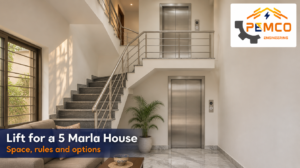
Where does that space come from in a typical Lahore house? Most often from the stairwell void, a corner of the lounge stacked through each floor, or a steel or glass shaft against an outside wall. If your home is on a small plot, our guide to a lift for a 5 marla house works through the space, the shaft position and the DHA and LDA height limits for a 25 x 45 ft plot. In a new house, ask your architect to leave a clear vertical space of at least 1.5 x 1.5 m from the ground slab to the roof, even if you fit the lift years later. A rough shaft space costs very little at the drawing stage and a great deal to cut in afterwards. Our home lift price guide for Pakistan shows how much that civil work can add to a quote. If your house is already built, our guide to adding a lift to an existing house covers where the shaft can go, cutting slabs safely and the approvals you need.
Plan for the person, not just the box. A walker or wheelchair needs a wider door and room to turn. A cabin that fits two standing adults may not take a wheelchair plus a carer.
Adding a lift to a house that was never designed for one also needs a structural check of the slab you cut through and the foundation under the pit. DHA Lahore’s lift installation guidelines require a stability certificate for houses as well as plazas, and a machine-room-less design has to be approved by the authority before installation.
Power supply: single-phase or three-phase?
Many compact home lifts run on an ordinary single-phase supply; larger traction lifts usually want three-phase. The Aritco model above, for instance, is offered for 230 V single-phase or 400 V three-phase with a 3 kW motor. Most Pakistani houses on a small sanctioned load are single-phase, so check this before you choose a model.
- Give the lift its own circuit and breaker from the main board, not a shared socket circuit.
- Proper earthing is mandatory under DHA’s guidelines and simply good practice everywhere.
- If the model needs three-phase and your house is single-phase, apply to your DISCO early. A phase change can take weeks.
- Ask the installer for the single line diagram (SLD). DHA lists it as mandatory, and any electrician will need it later.
What a home lift costs to run
The trips themselves cost very little. Standby power, the electricity the lift uses while waiting, is usually the bigger part of the bill. A study of European lifts by the University of Coimbra found standby ranged from 5% to 95% of a lift’s total energy, and was largest in residential lifts because they sit idle most of the day.
Here is a worked example for a three-storey Lahore house. The assumptions: 15 trips a day, about 25 seconds of motor time per trip, a 3 kW motor, a controller and display drawing 30 to 60 W, and a cabin LED light plus fan of about 55 W.
| Item | Units (kWh) per month |
|---|---|
| Motor running, 15 trips a day | About 9 |
| Controller and display on standby (30-60 W) | About 22-43 |
| Cabin light and fan left on 24 hours (about 55 W) | About 40 |
| Total, light and fan always on | About 70-90 |
| Total, light and fan switch off when idle | About 30-55 |
Households in Pakistan pay roughly Rs37 to Rs55 per unit before taxes, and NEPRA’s fuel and quarterly adjustments added about Rs2.58 a unit to bills this autumn. At Rs50 a unit, the lift above costs about Rs1,500 to Rs2,750 a month with sensible settings, or Rs3,500 to Rs4,500 with the light and fan left on all day.
Three ways to keep it low:
- Auto-off for cabin light and fan after a minute or two of no use. They still come on when the lift is called, as DHA requires a working light and fan.
- A controller with a sleep mode that powers down the door operator and display when idle.
- A VVVF drive (variable frequency) on traction lifts. It starts the motor smoothly and draws less current at each start than older two-speed motors.
One more Pakistan-specific point: if your house sits just under a slab boundary, especially the 200-unit line for protected consumers, an extra 40 to 90 units a month can move the whole bill into a higher rate. Look at your last twelve bills before you decide. Electricity is also only part of the running cost. Budget for a preventive maintenance contract every year too; DHA Lahore requires one, with a log book.
Want to know if a lift fits your house?
Send photos of your stairwell or plans on WhatsApp and our engineers will tell you which type fits and what space you need. Free site survey in Lahore and nearby areas, video consultation anywhere in Punjab.
Load-shedding and backup power
Every home lift in Pakistan needs a way to get people out when the power goes. An emergency landing device (ELD) or automatic rescue device (ARD) runs on its own battery, takes the cabin to the nearest floor and opens the doors. DHA Lahore’s guidelines list this backup as mandatory for houses as well as plazas, along with an alarm button, door interlocks, a speed governor and an emergency door key.
An ELD is a rescue device, not a way to keep using the lift through a two-hour outage (our guide to home lift backup during load-shedding explains the difference in detail). To run the lift normally during load-shedding you need a generator or an inverter and battery bank sized for the motor’s starting current, which is several times its running current. If you already have solar, a hybrid system can carry a small home lift in daylight, but the inverter must be sized for it. Our page on solar installation in Lahore explains how hybrid systems are sized.
When a home lift is not the right answer
A lift is a long-term fixture, and sometimes it is not the best spend:
- One person, one flight of stairs, wide straight staircase: a stairlift may do the job for much less and with no building work.
- You may sell or move within a few years: leave a shaft space instead and fit the lift later.
- No room for a shaft and no outside wall to build against: forcing a lift into a weak slab or a tight stairwell creates safety problems later.
- No one will maintain it: an unserviced lift is a hazard. If the household won’t keep up a maintenance contract, don’t install one.
If you are still deciding between models, our guide on how to choose a home elevator in Pakistan covers safety features, finishes and what to ask at handover.
Frequently asked questions
How much space do I need for a lift in my house?
For a small platform or screw-drive home lift, plan on a footprint of roughly 1.2 to 1.5 m each way, with little or no pit. A compact traction home lift needs a similar or slightly larger shaft, a pit of at least about 200 mm and clear height above the top floor of the car height plus around 650 mm. An engineer should measure your site before you commit.
How much electricity does a home lift use in a month?
In a typical house the lift motor itself uses only around 10 units a month. Standby power for the controller, display, cabin light and fan usually adds more, so a total of roughly 30 to 90 units a month is a realistic range, depending on how the lift is set up. Ask for automatic light and fan switch-off and a sleep mode on the controller.
Can a home lift run on a single-phase connection?
Many compact home lifts are built for single-phase 230 V supply, and some models offer either single-phase or three-phase. Larger traction lifts usually want three-phase 400 V. Check the exact model’s supply requirement before you buy, and ask your DISCO early if you need a three-phase connection.
What happens if the electricity goes while someone is in the lift?
With an emergency landing device (ELD) or automatic rescue device (ARD) fitted, the cabin moves to the nearest floor and the doors open. DHA Lahore’s lift guidelines make this backup mandatory for houses as well as plazas. It is a rescue device, not a way to keep using the lift for hours during load-shedding.
Is a lift worth it for a two-storey house?
It is worth it when someone in the house finds stairs hard or unsafe, such as elderly parents, a wheelchair user or someone recovering from surgery, or when you plan to stay in the house for many years. If everyone climbs stairs easily and you may move soon, a stairlift or simply leaving space for a future shaft can be the better choice.
Talk to an engineer about a lift for your home
PEMCO Engineering has installed home lifts, passenger lifts and cargo lifts in houses, commercial buildings and factories across Punjab. See our elevator and lift installation service. Call or WhatsApp 0322 4773987, or use the contact form for a free consultation.
Written by the PEMCO Engineering Team. Dimensions checked against manufacturer data and rules against DHA Lahore’s published lift guidelines on 15 November 2026. Running-cost figures are estimates; confirm specifications for your chosen model with the installer.